
Knee Surgeon Spokane County, WA and Coeur d’Alene, ID
We specialize in advanced knee replacement and knee treatment techniques. Dr. David F. Scott is a specialist in this field. He consults extensively with hip and knee replacement implant manufacturers, contributes significantly to the ongoing research in this field, and has been a contributor to many significant advances for knee replacement.
His current focus is on the use of the Kinematic Alignment surgical technique, coupled with Medial-Pivot knee implants.
The knee joint joins the thigh with the lower leg and consists of two articulations: one between the femur and tibia, and one between the femur and patella. It is the largest joint in the human body and is very complicated. The knee is a mobile trocho-ginglymus (a pivotal hinge joint), which permits flexion and extension as well as a slight medial and lateral rotation.
The knee is relied upon in your regular activity and motion, and a healthy knee allows you to walk, twist, and bend easily. Since in humans the knee supports nearly the whole weight of the body, it is vulnerable to both acute injury and the development of osteoarthritis. At OSC, we are skilled at treating knee injuries and providing care that will get patients moving again.
What Causes Knee Problems?
The knee is a complex joint with many components, making it vulnerable to a variety of injuries. Knee pain/injury is the most common reason for visiting an orthopaedic surgeon.
How Are Knee Problems Diagnosed?
- Medical history
- Physical examination
- Tests such as x-rays, ultrasound, and magnetic resonance imaging (MRI).
How Are Knee Problems Treated?
Knee problems are most often first treated with RICE (Rest, Ice, Compression, and Elevation):
- Rest. Don’t use the knee for 48 hours.
- Ice. Put an ice pack on the injured area for 20 minutes, four to eight times per day. Use a cold pack, ice bag, or a plastic bag filled with crushed ice wrapped in a towel.
- Compression. Put even pressure (compression) on the painful area to help reduce the swelling. A wrap or bandage will help hold the knee in place.
- Elevation. Keep the injured area above the level of the heart. A pillow under the Foot will help keep it up.
If pain and stiffness persist, see a doctor to diagnose and treat the problem. Who might use some of these solutions:
The symptoms and treatment of the knee vary, depending on the type of problem.
- Computer-aided and Robotically-Assisted Surgery
- Partial Knee Replacement (Unicondular Arthroplasty)
- Knee Implants
- Minimally Invasive Surgery
- Cement or Cementless Materials
- Biologic Reconstruction Alternatives
- Knee Arthroscopy
- Cartilage Transplant (OATS Allograft or Bulk Allograft)
- Meniscus Transplant (Allograft)
What Are the Most Common Knee Problems?
- ACL Injury
- MCL Injury
- PCL Injury
- LCL Injury
- Meniscal Injury
- Patellar Tendinitis
- Osteoarthritis of the Knee
- Patellar Fracture
- Patellofemoral Pain Syndrome
- Baker's Cyst
- Osgood Schlatter Disease
We specialize in advanced knee replacement techniques and now have outpatient options available for knee replacements right here in Spokane, Washington.
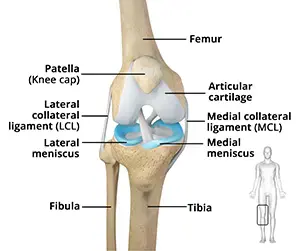
Anatomy of the Knee
The knee is a complex joint made up of different structures - bones, tendons, ligaments, and muscles. They all work together to maintain the knee’s normal function and provide stability to the knee during movement.
- Unicondylar Knee Replacement
- Knee Osteoarthritis Treatment
- Primary Knee Replacement
- Robotic Assisted Knee Replacement
- Partial Knee Replacement
- Outpatient Total Knee Replacement
- Minimally Invasive Surgery
- Knee Arthroscopy
- ACL Reconstruction
- Meniscal Surgery
- Total Knee Replacement
- Patellar Tendon Repair
- Knee Surgery
- Knee Implants
- Cement or Cementless Materials
- Biologic Reconstruction Alternatives
- Meniscus Transplant (Allograft)
- Meniscectomy
- Meniscal Repair Surgery
- Knee Trauma Reconstruction
- Knee Cartilage Restoration
- Knee Osteotomy
- High Tibial Osteotomy
- Tibial Tubercle Osteotomy
- Autologous Chondrocyte Implantation
- Proximal Tibial Osteotomy
- Physical Therapy for Knee
- Kinematic Alignment
- Outpatient Unicondylar Knee Replacement
- Computer-Aided and Robotically-Assisted Surgery
- Cartilage Transplant (Oats Allograft or Bulk Allograft)
- Knee Arthritis
- Osteoarthritis of the Knee
- ACL Injury
- MCL Injury
- PCL Injury
- LCL Injury
- Meniscal Injury
- Patellar Tendinitis
- Patellar Fracture
- Patellofemoral Pain Syndrome
- Baker's Cyst
- Osgood Schlatter Disease
- Patellofemoral Arthritis
- Knee Injury
- Knee Sprain
- ACL Tears
- Meniscal Tears
- Knee Ligament Injuries
- Knee Pain
- Articular Cartilage Injury (Knee)
- Knee Fracture
- Knee Sports Injuries
- Meniscus Root Tear
- Anterior Knee Pain
