
Hip Surgeon Spokane County, WA and Coeur d’Alene, ID
We specialize in hip care and advanced hip replacement techniques. Our very own Dr. David F. Scott, is a specialist in this field. He consults with parts manufacturers and contributes significantly to ongoing research in hip treatment. He has also collaborated in many significant advances for hip replacement.
The hip joint is formed by the articulation of the rounded head of the femur and the cup-like acetabulum of the pelvis. Its primary function is to support the weight of the body in both static (e. g. standing) and dynamic (e. g. walking or running) postures. It forms the primary connection between the bones of the lower limb and the axial skeleton of the trunk and pelvis. Both joint surfaces are covered with a strong, lubricated layer called articular hyaline cartilage. A thin neck region attaches the shaft to the head of the femur which leads into the hip. This area is often prone to fracture in the elderly, mainly due to the degenerative effects of osteoporosis.
Overall, the hip joints are a determining factor in retaining balance. The pelvic inclination angle, which acts as the single most important element of human body posture, is adjusted at the hips.
What Causes Hip Problems?
The hip joint—the body’s largest ball-and-socket joint—fits together to allow for fluid movement. The ball-like top of your thigh bone moves within a cup-like space in your pelvis. For this reason, whenever the thigh bone moves in the hip socket, a cushion of cartilage helps prevent friction. The hip’s design thus promotes its ability to withstand repeated motion and a fair amount of wear and tear. Despite its durability, however, the hip joint isn’t indestructible. Due to age or use, injury or arthritis, the cartilage can wear down or become damaged. Muscles and tendons in the hip can get overused. The hip bone itself can fracture during a fall or other injury. Any of these conditions can lead to hip pain or problems.
How Do We Diagnose Hip Problems?
Evaluation may include
- Medical History
- Physical Examination
- X-Ray
- MRI
- Bone Scan
How Do We Treat Hip Problems?
What Are the Most Common Hip Problems?
- Arthritis
- Trochanteric Bursitis
- IT Band Syndrome
- Osteonecrosis of the Hip
- Hip Snapping
- Hip Fracture
- Stress Fracture of the Hip
Outpatient Hip Replacement
We specialize in advanced hip replacement techniques and now have outpatient options available for hip replacements right here in Spokane, Washington.
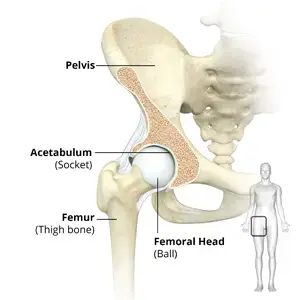
Anatomy of the Hip
The hip joint is the largest weight-bearing joint in the human body. It is also referred to as a ball and socket joint and is surrounded by muscles, ligaments, and tendons. The thigh bone or femur and the pelvis join to form the hip joint.
- Total Hip Replacement
- Outpatient Hip Replacement
- Robotic Assisted Hip Replacement
- Primary Hip Replacement
- Minimally Invasive Total Hip Replacement
- Hip Labral Reconstruction
- Hip Fracture Surgery
- Hip Reconstruction
- Hip Surgery
- Hip Trauma Reconstruction
- Hip Implant Options
- Hip Tenotomy
- Minimally Invasive Surgery
- Proximal Femoral Osteotomy
- Femoroacetabular Osteoplasty
- Periprosthetic Hip Fracture Management
- Robots/Computers-Technology-Assisted Surgery
- Outpatient Anterior Approach Hip Replacement
- Arthritis
- Trochanteric Bursitis
- IT Band Syndrome
- Osteonecrosis of the Hip
- Hip Snapping
- Stress Fracture of the Hip
- Hip Fracture
- Osteoarthritis of the Hip
- Hip Dislocation
- Hip Pain
- Hip Injury
- Femoroacetabular Impingement
- Hip Labral Tear
- Hip Instability
- Periprosthetic Hip Fractures
- Iliopsoas Impingement
- Acetabular Fracture
- Femoral Neck Fracture
- Avascular Necrosis
- Hip Tendonitis
